How often to check: no international reference sets the frequency
The European guidelines say to check “regularly” without going into detail, and they’re not alone. The interval is set further down, at the national, regional, or hospital level, and the people who set it reach different conclusions.
The Resuscitation Council UK spells this out in its Quality Standards for cardiopulmonary resuscitation, first published in November 2013 and updated in July 2023: “A reliable system of equipment checks and replacement must be in place to ensure that equipment and drugs are always available for use in a cardiac arrest.” But “the frequency of checks should be determined locally.”
In France, the reference point is certification. The good-practice guidance from OMéDIT Centre follows the certification requirements of the HAS (Haute Autorité de Santé), the French body that certifies the quality of hospitals and clinics. It falls under a mandatory guideline: care teams must be able to manage life-threatening emergencies. This leads to two frequencies and one obligation. Carts must be checked regularly based on the risks of each unit, and at least once a month. After every use, they are checked, restocked, and resealed. And each check must be traceable, with the date and the name of the person who did it, in a log that’s kept up to date.
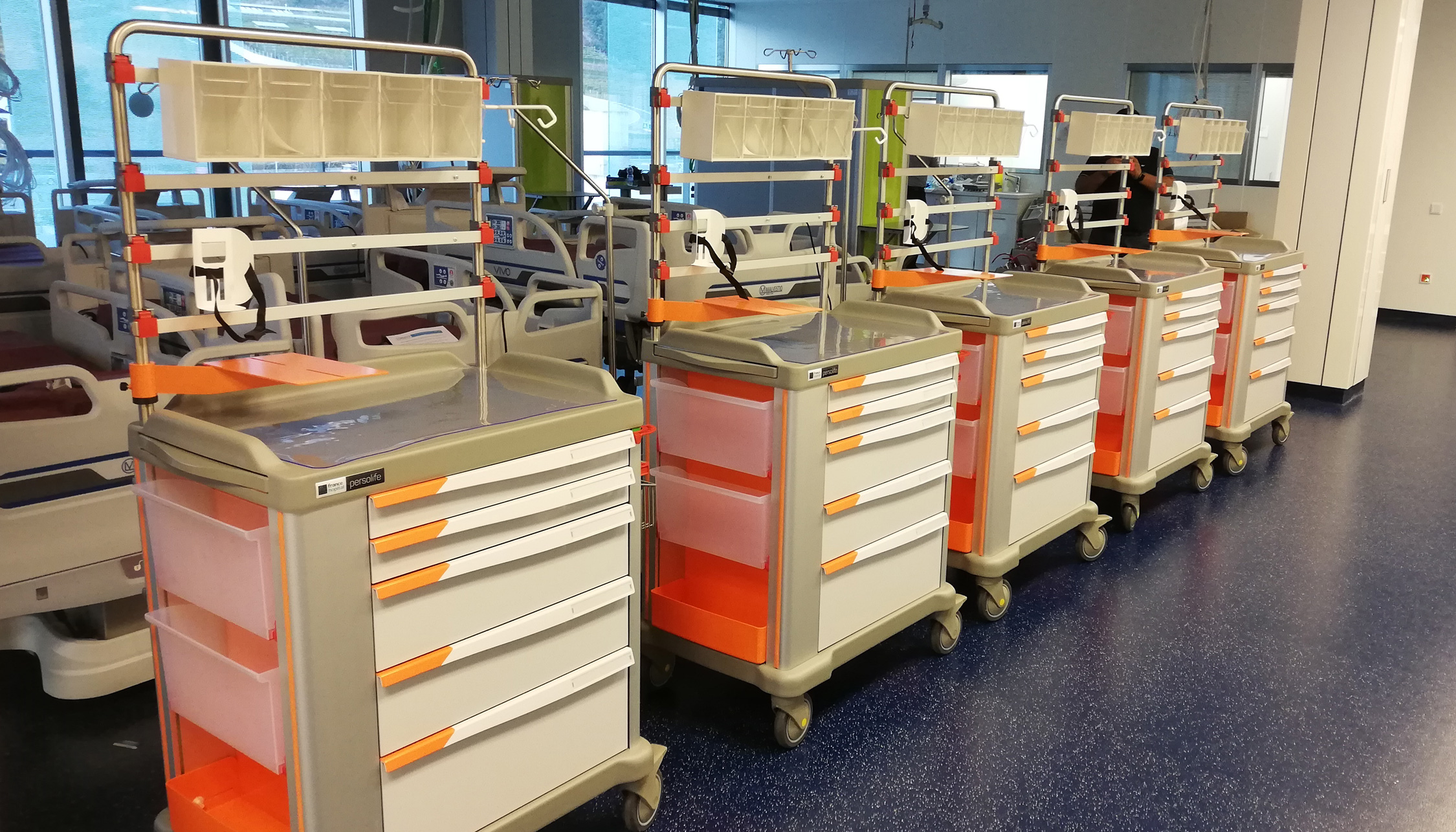
The same text includes a requirement that concerns the cart itself rather than the procedure: the oxygen cylinder must be secured to the crash cart, and when that isn’t possible, it must be stored in a dedicated, labeled place reserved for the crash cart only.
In the United States, the focus shifts from frequency to the device. In a set of frequently asked questions published in 2016 and updated in 2021, the Joint Commission addresses crash cart security and warns against locks that slow staff down. Devices such as padlocks, which could create delays or barriers to immediate access to emergency medications, are discouraged and could be interpreted as “not readily accessible for use.” When a security device is used, it should detect tampering without creating a barrier or delay in staff access to the contents.
This matters directly to anyone writing a tender: a breakaway seal with an ID number is acceptable, as long as there’s a defined process for monitoring its integrity. The device alone isn’t enough. What makes it acceptable is a procedure that someone carries out and records.
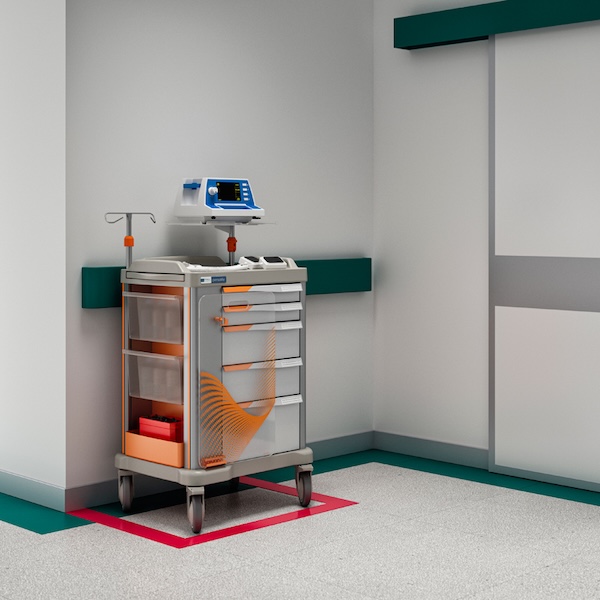
A second FAQ explains what hospitals gain in return. A cart closed with a breakaway seal can be placed wherever it’s clinically needed, from the emergency room to a niche in a ward corridor, even without constant visual monitoring by staff, as long as that process for monitoring the seal and contents is in place. The procedure is what makes the location possible, not the other way around.
In Italy, the decision is made at the level of each hospital or health authority, and the procedures we reviewed (chosen because they’re freely available online) take different approaches. They come from Federico II University Hospital in Naples, Italy (revision 03, December 13, 2018), ASL 1 Sassari for the hospitals in Ozieri and Alghero, Italy (2022 edition), ASL Latina, Italy (version 4, January 20, 2025), ASP Ragusa, Italy (revision 02, February 11, 2022), and ASP Trapani, Italy, for psychiatric services (March 2, 2018).
For checking the contents, almost all of them settle on once a month, in line with the French minimum. For the seal, though, they differ: several include it in the daily checks, while Sassari requires the cart to be checked at the start of every shift. Latina checks medications and equipment weekly or monthly. Trapani has three levels: daily, weekly, and monthly. Ragusa checks equipment daily, and medications and supplies monthly.
Five procedures are obviously not a representative sample. But set alongside the British, French, and American references, they point to one thing: the reference framework doesn’t set the frequency, and actual schedules vary from country to country and from hospital to hospital.