During 2025, the medications bought directly by Italian public hospitals cost €15.9 billion. The plan was 11.2 billion. The gap against the legal ceiling is 4.7 billion. In the same year, spending on medicines dispensed by contracted pharmacies stayed under its own ceiling (AIFA, pharmaceutical spending monitoring, January–December 2025, published 9 June 2026). The hospital channel is the one under most pressure.
That gap does not come from logistics: it comes mostly from high-cost medications. But the hospital is the channel where every avoidable penny shows up most clearly.
It is also the channel where hospitals have started to buy something different. In the logistics contracts signed with public facilities over the last two years, modular logistics went from a historical 8% of the total to 18% (Osservatorio Contract Logistics “Gino Marchet”, Politecnico di Milano, 2025 edition).
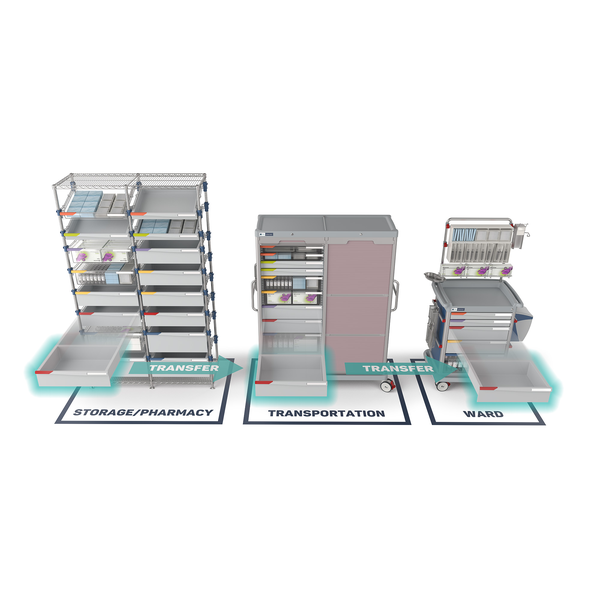
Those contracts do not buy furniture and drawers. They buy logistics services, and they change what the hospital asks for in the first place. If you choose modular logistics, you have to describe how material moves through the building: how many times it changes container, who handles it, where it loses its label. Tenders are following this shift.
So what is bought is not just furniture. It is a flow that the hospital pays for over years. It pays in staff time and in material that expires before anyone uses it. Those costs are not in the quote, and they are worth looking at before signing.
Here we set out the criteria that get the medication to the right bed, at the right time, without losing it on the way.